Access Denied
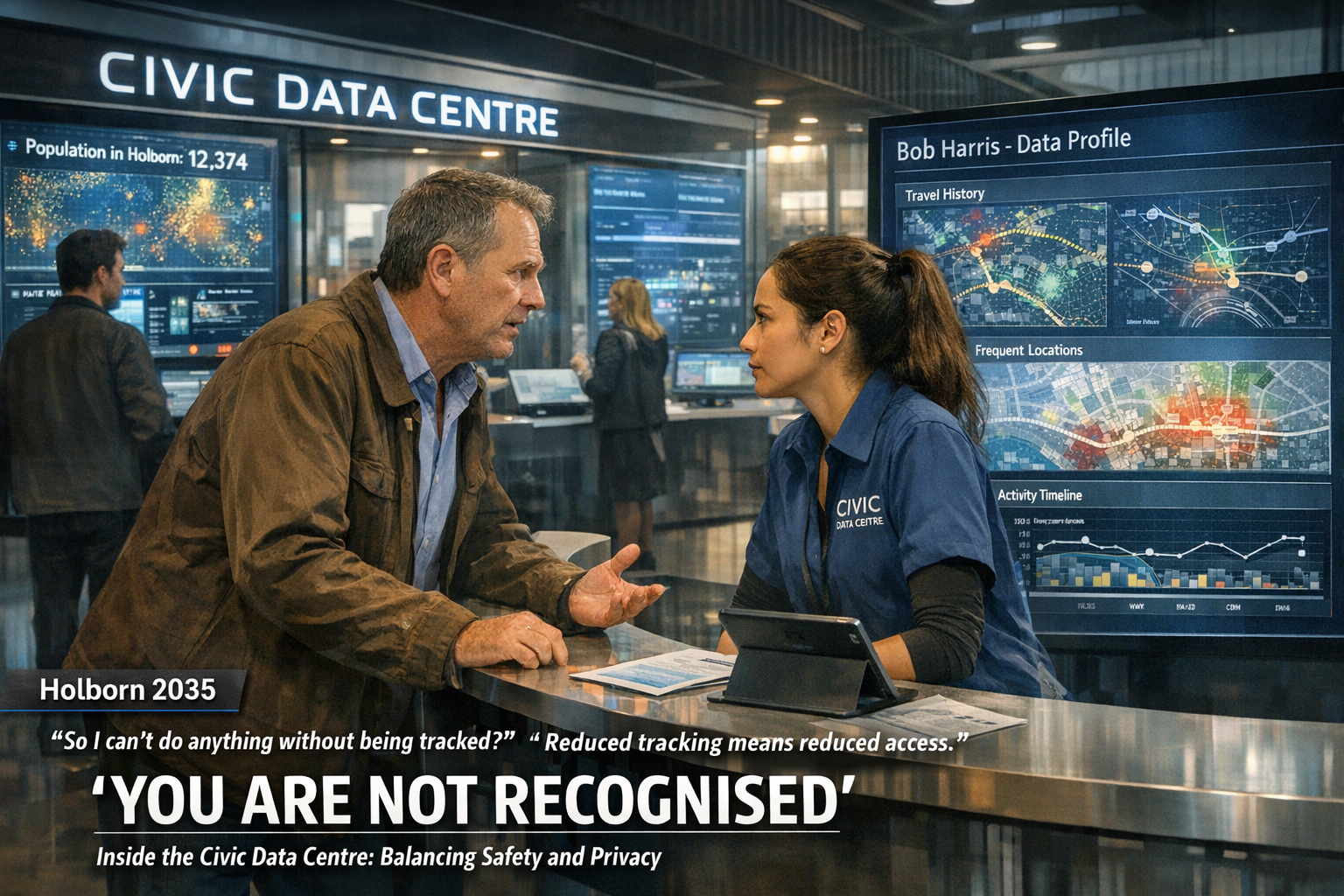
Image taken by Gemini
At 8:42 a.m. yesterday, commuter Bob Harris stepped onto the platform at Holborn Station like he had done for years. Same route. Same train. This time, the barrier didn’t open. Instead, a calm blue message flashed across the glass gate: “You are not recognised by the Holborn Network. Please visit the Civic Data Centre.”
“I honestly thought it was a glitch,” Bob told the Holborn Herald, standing outside the Civic Data Centre later that afternoon. “Then I realised—no, it’s not broken. I’m the one who’s been switched off.”
Over the last decade, Holborn’s systems—cameras, travel cards, phone-based location services, and retail data—have merged into a single, city-wide network. Officials say it’s designed to keep the area efficient and safe: smoother travel, reduced crime, faster emergency response. But for Bob, who had disabled his location tracking app the week before, the network didn’t see safety. It saw absence.
“I couldn’t get on the train. My phone payment didn’t work in the shop. Even the café near my flat asked me to ‘reconnect to continue service,’” he said. “That’s when it hit me—I wasn’t just offline. I was locked out.”
The Civic Data Centre sits in the heart of Holborn, a glass-and-steel building somewhere between a library and a tech hub. Inside, wall-sized screens glow with live statistics: crowd density, footfall heatmaps, transport flow. At a help desk, Bob spoke with Leila Morgan, a Civic Data Advisor.
“So you’re saying I can’t live normally unless I’m tracked?” Bob asked. “No,” Leila replied. “What I’m saying is that reduced tracking comes with reduced access. It’s a choice.” “It doesn’t feel like a choice if I can’t even buy food.”
Leila showed Bob his data profile: travel routes, frequent locations, time patterns. Everything neatly logged. Everything optional—technically. “You can limit what’s collected,” she explained. “But you won’t be able to enter high-density zones, use automated transport, or access most retail services.”
Bob stared at the screen. “So privacy is allowed,” he said quietly, “as long as you don’t need the city.”
Outside the building, opinions were split. “I love it,” said Amira, a local shop owner. “The streets feel safer. I know if something happens, help is already on the way.” Others weren’t so sure. “It’s weird seeing your life reduced to dots on a screen,” said Jon, a student. “I’d rather not know how much they know.”
In the end, Bob re-enabled his location tracking. “I didn’t agree with it,” he said. “But I also didn’t have a real alternative.” By the evening, his travel card worked again. Shops accepted his payments. The city recognised him once more.
Still, as he left the Civic Data Centre, Bob paused and looked back at the glowing screens behind the glass. “They say it’s for safety,” he said. “But I’ve never felt more watched—or more trapped.”
As Holborn continues to refine its network, one question is becoming harder to avoid: in a city where everything is connected, is privacy still a right—or just another premium feature? For now, Holborn is safer than ever. Whether it’s freer is another story.